Reconstructing the quills

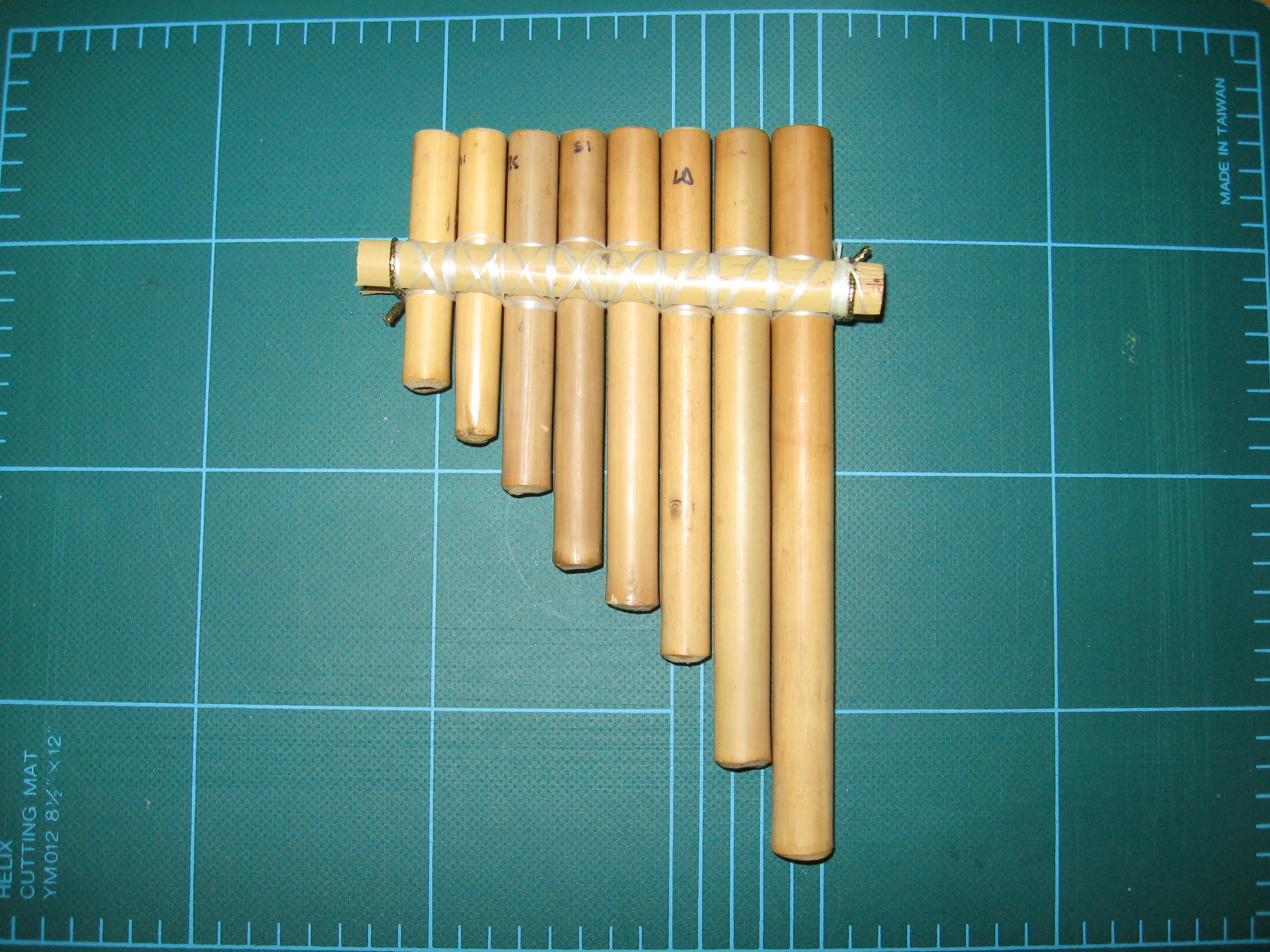
See the post The Quills: the forgotten American folk woodwind for general information about the American instruments known as the quills. African players make their own instruments, and I imagine that Henry Thomas did as well. Recent players of the cane fife in America do so as well. So, what do you need to know in order to make a historically accurate instrument? First off, you need to understand the difference between the cane fife (quills) and the panpipe form of the instrument, and decide which one you want to pursue. There are modern players and makers of the cane fife form of the instrument, so for the moment I’m going to concentrate on the panpipe version made famous by Henry Thomas. ...

January 18, 2011 · 10 min

Practical Acoustics of pan Pipes

As of this writing, there is no good source of practical information available regarding the construction of pan pipes, so I did a couple of tests to establish some general principles for pan-pipe scaling. The question I was trying to answer was: Given a pitch, what is the ideal internal length and diameter of the pipe? Since cane is a natural material, it will not conform to the precise dimensions defined here, however these numbers should provide a reasonable starting point for experimentation. ...

January 14, 2011 · 3 min

Break cane for fun and profit

Arundinaria Gigantea Known as: Cane Southern Cane Cane Reed Switchcane Canebrake Bamboo Macon Rivercane (a specific variety available as an ornamental plant) I’ve collected this information from many sources on the web, while I searched for a source of cane for my Quills project. I put it here for the benefit of those who don’t want to spend the time searching. The plant is native to the southern U.S. Although cleared to near extinction, it still can be found in wetlands and well drained floodplain forests. It is found in canebrakes, thick clusters of plants that grow up to 25 feet high and up to a diameter of 1 and even two inches. ...

January 2, 2011 · 3 min

A French grand cornemuse, 18th c, private collection

The instrument is incomplete, with some parts modern.  The chanter is known to be original, and the top joint of the bass drone known to be a reproduction. These images are based on full-size xerox originals, which are (unfortunately) the best quality images I have at hand.  The pewter inlay is particularly spectacular on this instrument. The images have been scaled to fit on the page, but the files are actually at much higher resolution.   They can be downloaded and viewed in any image editing program.  These images are not displayed to scale on this page, but the source images should scale correctly. ...

June 15, 2005 · 2 min

3d renderings of renaissance recorders

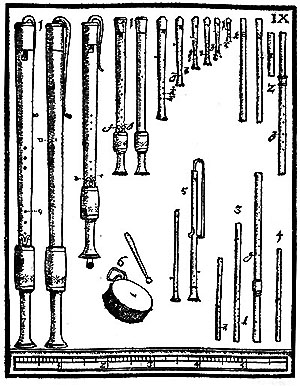
Renaissance recorders were popular throughout Europe from about 1500 to 1650. They were among the most popular “consort” instruments, meaning that they were played in groups (or consorts). A typical consort for renaissance recorders would be made up of one alto, two tenors, and a bass instrument. Michael Praetorius, writing in 1618, expressed a preference for a consort made up of a tenor, two bass recorders, and a great bass. Praetorius also mentions an “ideal” consort made up of 21 instruments, made in 7 different sizes. He illustrated these instruments in his encyclopedic Syntagma Musicum. ...

February 2, 1996 · 2 min